BabyBuddha 2.0 Review
If you’ve been searching for a compact breast pump that doesn’t compromise on power, chances are the BabyBuddha has popped up on your radar. In this BabyBuddha 2.0 review, I’ll walk you through everything you need to know about this upgraded portable pump, from suction strength and battery life to comfort and ease of use, so you can decide if it’s the right fit for your pumping routine.
The BabyBuddha 2.0 is marketed as a hospital-grade, portable breast pump designed for moms who need both flexibility and strong, consistent suction. With multiple stimulation and expression modes, quiet operation, and a lightweight motor that’s smaller than most smartphones, it promises to make pumping on the go more practical than ever.
But how does it really perform day to day? And is it worth investing in the BabyBuddha over other portable breast pumps on the market like the popular Elvie Stride? Let’s take a closer look at the features, pros, and cons of the BabyBuddha 2.0 to find out.

Photo credit: Pumping Milk
Editor’s note: Pumping Milk is reader-supported, meaning, at no cost to you, I may earn a commission if you buy after clicking an affiliate link. Learn More.
Check If You Can Get a Free Breast Pump Through Insurance
Most moms qualify for a 100% free breast pump through their insurance plan, including popular brands like Spectra, Medela, Elvie, Willow, and Baby Buddha. It takes less than a minute to check.
My BabyBuddha 2.0 Review
The BabyBuddha 2.0 is marketed as a hospital-grade portable pump designed for moms who want strong suction in a lightweight package. Unlike fully wearable pumps, it uses a pump-to-bottle setup with long flange tunnels, making it especially helpful for elastic nipples and those who need reliable output.
For me, the BabyBuddha feels like one of the few compact pumps that actually rivals larger, full-sized models in terms of suction. It’s small, easy to carry with its lanyard, and operates quietly enough at around 42 dB to blend into background noise.
So, is the BabyBuddha 2.0 worth it? In this BabyBuddha breast pump review, I’ll share what I love about it, where it falls short, and who I think it’s best suited for.
What I Love About the BabyBuddha 2.0
When I review a breast pump, I look at suction, efficiency, comfort, ease of use, portability, and overall value. The BabyBuddha 2.0 hits several of these categories really well.
For me, the standout is the strength packed into such a small motor. Many portable pumps struggle to compete with full-sized electrics, but the BabyBuddha is different. With hospital-grade suction ranging from 53–315 mmHg and three pumping modes, including the unique mixed mode suction pattern, it’s powerful enough for exclusive pumping, not just quick sessions on the go.
I also love that it’s surprisingly quiet. At around 42 dB, it has a lower-pitch hum compared to many portable or wearable pumps. In practice, that means it blends into background noise really well I doubt most people would even notice it if you’re on a call or chatting nearby.
Another big plus is the lightweight design and lanyard carry option. Instead of trying to balance a pump in your pocket or juggle extra bags, you can wear the BabyBuddha comfortably around your neck and move about freely. It makes multitasking much easier, especially if you’re pumping multiple times a day.
Ease of use is another highlight. The BabyBuddha 2.0 replaces the rollerball with simple button controls on the early 1.0 model, making it quicker to switch between modes and suction levels without a learning curve. The addition of an LCD screen with a built-in timer is a big improvement, letting you keep track of your session length at a glance.
I also appreciate the durability and warranty. With a two-year motor warranty (double what most pumps offer), the BabyBuddha has a reputation for lasting long beyond the typical portable pump lifespan.
And finally, price matters. At around $210, the BabyBuddha 2.0 sits in a really reasonable spot for a portable, hospital-grade pump. It feels like you’re getting premium-level suction without paying premium wearable pump prices.

Photo credit: Pumping Milk
Performance & Efficiency
The BabyBuddha 2.0 breast pump is proof that portable doesn’t have to mean underpowered. With hospital-grade suction strength from 53–315 mmHg, this compact motor delivers the kind of performance you’d expect from a full-sized electric pump. For moms who pump multiple times a day, or even exclusively, the BabyBuddha portable pump has the consistency to keep up.
The 2.0 features three distinct modes to cover every stage of a session:
- Soft Stimulation – a gentle start designed to trigger letdown comfortably. It has six suction levels so you can fit a comfort level to suit your body.
- Stimulation Mode – a faster rhythm with six suction levels, giving you flexibility as milk flow begins.
- Expression Mode – deeper, slower pulls with nine suction levels for efficient milk removal.
What stands out to me is the consistency of suction across sessions. Unlike some smaller hands-free pumps that fade in strength, the BabyBuddha 2.0 maintains steady output until you’re finished, which makes it more reliable for protecting supply.
Another improvement over the original BabyBuddha is the way the 2.0 handles suction patterns. The first version’s mixed-mode pull could feel overly strong and even uncomfortable. The updated BabyBuddha 2.0 pump still provides plenty of power, but in a smoother, more controlled way that’s gentler on sensitive nipples while still helping you empty effectively.

Photo credit: Pumping Milk
Design
The BabyBuddha 2.0 pump keeps things simple, compact, and practical. Instead of an all-in-one wearable design, this is a pump-to-bottle system where milk flows directly into collection bottles. I really like this approach because it cuts out extra steps as you can pump straight into a bottle, cap it, and store without transferring.
The bottles are a 4oz capacity, which is on the smaller side, but is still ample for most moms without needing to empty or replace mid-session.
Weighing only 8 ounces (225 g), the motor is quite light in comparison to other portable pumps like the Medela Freestyle. It’s small enough to slip into a pocket or bag and even comes with a lanyard strap, so you can wear it around your neck and stay mobile while pumping.

Photo credit: Pumping Milk
Comfort
Comfort often comes down to flange design, and the BabyBuddha breast pump does a good job here. It comes with 24 mm flanges as standard, which are paired with long tunnels. That extra depth is especially useful for moms with elastic nipples, since it reduces rubbing and gives more room during suction.
There are no other flange sizes included, which is a bit disappointing. It’s not a deal breaker, but it does mean you’ll need to know your nipple size before ordering so you can also purchase the correct flange sizes separately.
The suction itself is strong but not harsh when the settings are adjusted correctly. With three distinct modes, Soft Stimulation, Stimulation, and Expression, you can ease into pumping gently before moving into deeper pulls. Having multiple modes helps prevent the pinching or discomfort some hospital-strength pumps can cause.
I also find the way the motor is separate from the collection bottles adds to the overall comfort. Because the weight of the pump isn’t sitting directly on the breast like it would with a wearable, the cups feel lighter and less fatiguing during longer sessions.
Noise
The BabyBuddha 2.0 pump runs at about 42 dB, which is quieter than many portable breast pumps. It gives off a steady, low-pitched hum that blends into background noise, making it discreet enough for phone calls, work, or nighttime pumping.
User-Friendliness
In terms of user-friendliness I think the BabyBuddha 2.0 is fairly simple to operate. It uses button controls paired with an LCD screen that shows your suction level, mode, and session time at a glance. I like that the built-in timer means you don’t need to track your sessions manually.
There’s no app integration with the BabyBuddha pump, which could be a drawback if you’re used to smart pumps that log your data automatically. But for moms who prefer straightforward controls without extra setup, the lack of app dependency makes it quick and intuitive to use.
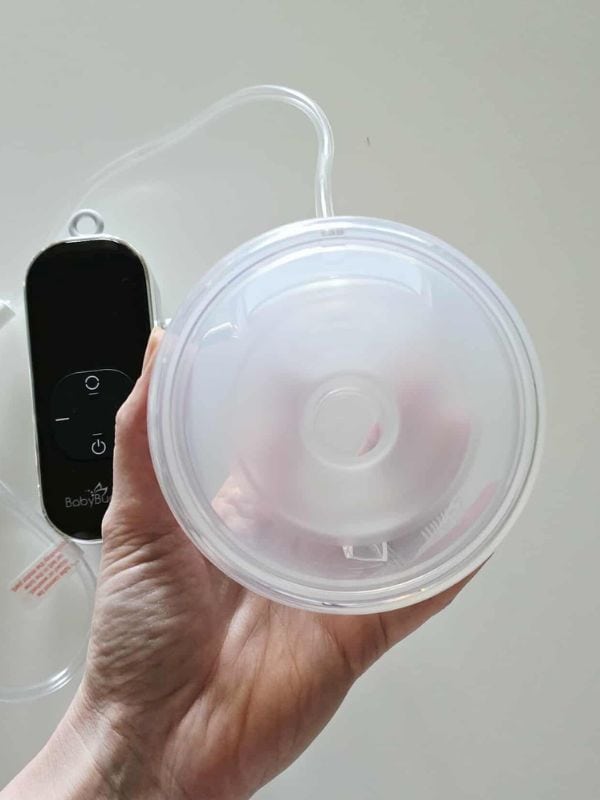
Photo credit: Pumping Milk
Portability
Whilst the BabyBuddha portable pump is built with portability in mind, for me it does have a few limitations. Specifically, the battery life! On a full charge, you’ll only get around 60 minutes of use, which usually works out to 2–3 sessions. While it recharges fairly quickly via USB, you’ll likely find yourself topping it up often if you’re pumping multiple times a day.
There are a few pluses though, like the small, lightweight design of the pump motor, and the pump-to-bottle design for pumping on the go. Since milk flows directly into the collection bottles, you can cap them right away for storage without transferring into another container. This makes the BabyBuddha breast pump a convenient option for travel or pumping at work.
Though I will add, due to the pump to bottle design, it is not discreet like a wearable breast pump that is concealed within your bra. That said, you can purchase the BabyBudda collection cups separately which does add that in-bra discretion. These collection cups integrate seemlessly with the BabyBudda pump.
Cleaning
The BabyBuddha 2.0 breast pump is straightforward to clean thanks to its minimal part design. Each side only has a few key components, the bottle, flange, diaphragm, valve, and backflow protector, which makes assembly and washing less time-consuming compared to bulkier pumps.
All milk-contact parts are made from BPA-free materials and are safe for multiple cleaning methods. You can wash them on the top rack of the dishwasher, boil them for five minutes, or use steam/UV sterilizers as long as the temperature doesn’t exceed 212°F. They’re also compatible with microwave steam bags, which is handy if you need a quick clean at work or while traveling.
Because the BabyBuddha is a closed-system pump, milk never enters the tubing or motor, which keeps things hygienic and reduces the risk of contamination.
Value for Money
At around $210, the BabyBuddha 2.0 breast pump sits in a mid-range price point that feels very fair for what it offers. You’re getting hospital-grade suction up to 315 mmHg, three modes with 14 total suction levels, and a compact motor that’s light enough to wear on a lanyard. I feel like these are features that many pumps at this price don’t always deliver.
I also like that the BabyBuddha 2.0 comes with a 2-year motor warranty, which is generous compared to the one-year coverage most breast pump brands provide. That extra durability and support helps justify the price, especially if you plan to use it daily.
It doesn’t come loaded with accessories, you’ll need to purchase additional flange sizes or storage options separately, but for moms who want strong suction, quiet performance, and a reliable closed-system pump in a compact design, I think the BabyBuddha pump offers excellent value for money.
What I Wish Was Different
While I feel the BabyBuddha 2.0 breast pump has a lot going for it, there are a few areas I think are worth considering before you decide if it’s the right fit:
- Battery life – At only 60 minutes per charge, the battery feels short compared to other portable pumps. You’ll likely need to recharge daily, which can be inconvenient for frequent pumpers.
- Strong suction pulls – While the 2.0 is gentler than the original, some moms still find the long, deep pulls intense. If you’re sensitive or prone to nipple soreness, you may need to start on the lowest settings until you adjust.
- Preset settings – Suction and speed are linked together in fixed patterns across the 14 levels. That means you don’t get full control over cycle length versus suction strength, which may not suit every mom’s preference.
- Flange sizing – The pump only comes with a 24mm flange, and while additional sizes are available (21mm, 28mm, and 32mm), finding the perfect fit can be tricky. With the stronger pull style, fine-tuning your flange size and shape is especially important for both comfort and milk output.
- Pump-to-bottle design – Practical for storage, but less discreet than cup-based pumps. The tubing and motor mean it’s portable but not a true wearable option.
None of these are dealbreakers for me, especially considering the strength and price point, but they’re worth keeping in mind as you weigh if the BabyBuddha 2.0 matches your pumping routine.
The Verdict
All in all, I believe the BabyBuddha 2.0 breast pump packs a lot of strength into a small, portable design. With hospital-grade suction up to 315 mmHg, multiple modes, and a lightweight motor you can wear on a lanyard, it’s one of the most powerful portable pumps available today. I especially like the simple button controls, LCD timer, and straightforward pump-to-bottle setup that makes storing milk easy.
That said, it isn’t perfect. The shorter battery life, preset suction patterns, and limited accessories may be drawbacks depending on your needs. And while the suction is effective, some moms may find it intense until they adjust their flange fit and settings.
I think the BabyBuddha 2.0 is best suited for moms who want hospital-grade performance in a compact, portable pump, whether as a reliable secondary option or even a main pump for those who don’t mind shorter battery life. If app features or all-day runtime are top priorities, another pump might be a better fit. But if you’re after portability, power, and proven durability, the BabyBuddha 2.0 is definitely worth considering.

Photo credit: Pumping Milk